
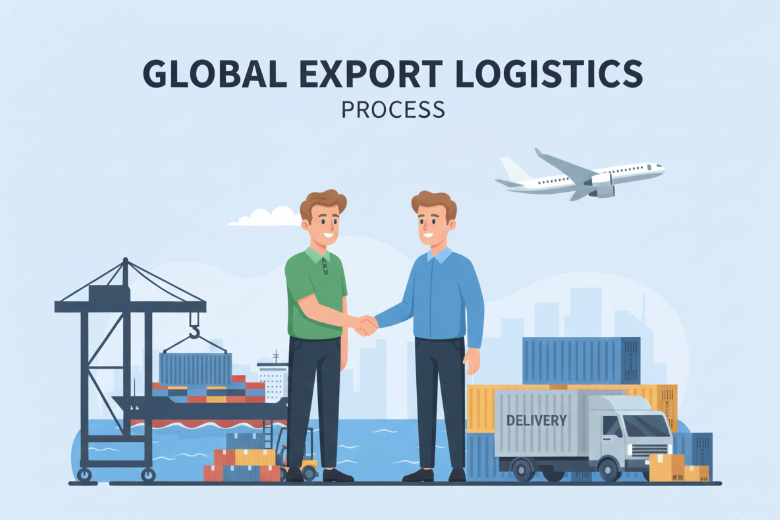
Exporting goods for the first time can seem complex because it involves documentation, customs procedures, and coordination with ports and shipping lines. However, when broken down step by step, the export process follows a clear and logical flow.
This blog explains the complete export process, from the factory stage to loading goods on the ship, in simple language so that even a first-time exporter can understand where they are and what comes next.
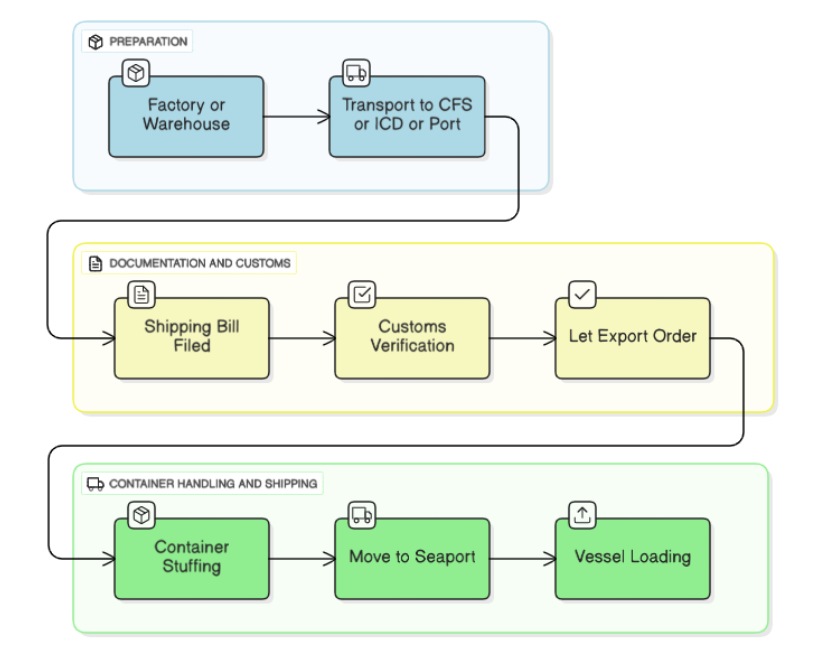
Step 1: Goods Preparation at the Factory
The export process begins at the exporter’s factory or warehouse.
Once the goods are manufactured or ready for dispatch, they are packed according to international shipping standards. Proper packing is important to protect goods during handling and transit.
At this stage, the exporter prepares the basic export documents:
- Commercial Invoice
- Packing List
- Any commodity-specific licenses or certificates (if required)
These documents describe the goods, their value, quantity, and how they are packed.
- [Sample Commercial Invoice – Download]
- [Sample Packing List – Download]
Step 2: Movement of Goods to Port or Dry Port (CFS / ICD)
After packing, the goods are transported from the factory to a customs-bonded location. This can be:
- A seaport warehouse, or
- A dry port such as a Container Freight Station (CFS) or Inland Container Depot (ICD)
These locations are under customs control and are used to store export cargo before shipping.
At this point, the goods are inside a customs-bonded area, meaning they cannot be moved or exported without customs approval.
Step 3: Filing Export Documents with Customs (Shipping Bill)
Once the goods reach the CFS, ICD, or port warehouse, export documents are filed with customs.
A Shipping Bill is generated using the commercial invoice and packing list. This is filed electronically on the customs portal (for example, ICEGATE in India). The shipping bill is the official declaration that goods are being exported.
Customs uses the shipping bill to:
- Verify export details
- Check compliance with regulations
- Assess eligibility for export incentives (if applicable)
- [Sample Shipping Bill – Download]
Step 4: Customs Verification and Examination
After the shipping bill is filed, customs officers verify the submitted documents. They check:
- Whether the declared value is correct
- Whether the goods description matches the documents
- Whether export regulations are being followed
In some cases, customs may physically examine the cargo. During examination, the goods are opened (if required) and matched with the shipping bill, invoice, and packing list.
Not all shipments are examined, but if selected, examination is mandatory.
Step 5: Let Export Order (LEO) Is Issued
If customs is satisfied with the documents and examination results, they issue a Let Export Order (LEO).
LEO is a critical milestone in the export process. It means customs has officially approved the shipment for export.
Without LEO, goods cannot be loaded onto a vessel.
- [Sample Let Export Order (LEO) – Download]
Step 6: Container Booking and Cargo Stuffing (FCL Shipments)
For Full Container Load (FCL) shipments, containers are booked with a shipping line. Cargo stuffing can happen in two ways:
Option 1: Stuffing at CFS / ICD
In this method:
- An empty container is brought to the CFS or ICD
- Cargo is loaded into the container at the warehouse
- The shipping line seal is applied
- Customs seal may also be applied
- Verified Gross Mass (VGM) is submitted
- The container is transported by road or rail to the seaport
- [Sample VGM Declaration – Download]
- [Sample Container Stuffing Report – Download]
Option 2: Factory Stuffing (With Customs Permission)
If the exporter’s factory has customs approval:
- The empty container is sent directly to the factory
- Cargo is stuffed at the factory itself
- Electronic seal or customs seal is applied
- Seal details are updated in the customs system
- The container is moved to CFS or port for verification
If customs selects the container for examination, the seal is opened and a new customs seal is applied after inspection.
Step 7: Container Is Loaded on the Vessel
Once the container reaches the seaport:
- It is loaded onto the vessel
- The vessel sails to the destination country
- The shipping line issues the Bill of Lading (BL)
The Bill of Lading is a very important document as it acts as:
- Proof of shipment
- Contract of carriage
- Document of title
- [Sample Bill of Lading – Download]
At this stage, the export process from the origin country is complete.
How to Know Where You Are in the Export Process
- Invoice and packing list prepared → Export has started
- Shipping Bill filed → Under customs processing
- LEO issued → Cleared for export
- Container stuffed and sealed → Ready for port movement
- Vessel sailed → Cargo in international transit
Final Note for Exporters
Understanding the export process helps avoid delays, penalties, and unnecessary costs. While documentation and customs procedures may appear complex, working with a reliable logistics partner ensures smooth execution at every stage.
This structured approach helps first-time exporters clearly understand the flow and track their shipment confidently.